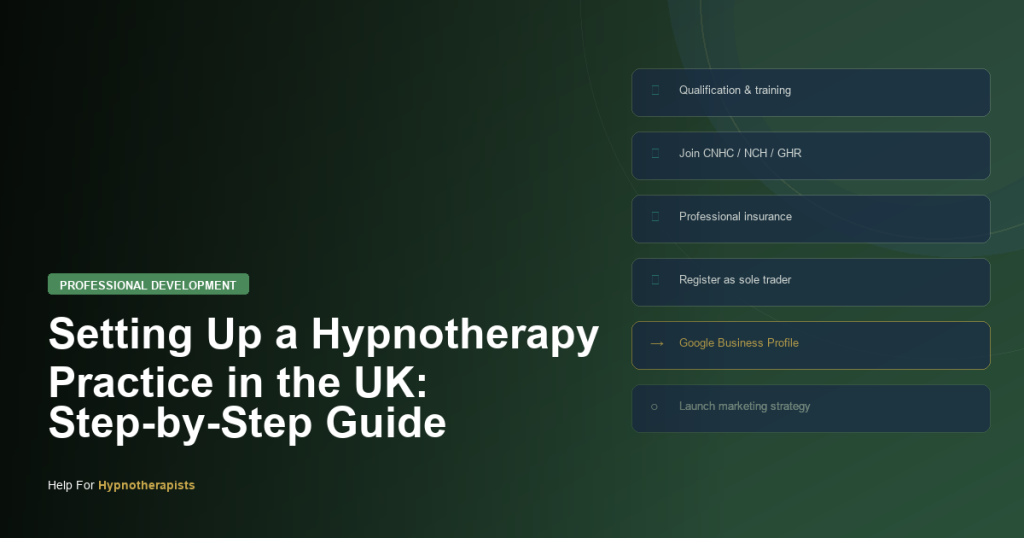
Setting Up a Hypnotherapy Practice in the UK: A Step-by-Step Guide
Starting a hypnotherapy practice in the UK is genuinely achievable — but the gap between completing your training and running a profitable, professional business is wider than most courses prepare you for. Qualification questions, association memberships, insurance, business registration, workspace decisions, and marketing all land on your desk at once, and it’s easy to get stuck before you’ve seen your first paying client. This guide cuts through the noise with a clear, sequenced walkthrough of every step you need to take.
Unlike many professions, hypnotherapy is not statutorily regulated in the UK. That means there is no single legal requirement to practise — but it also means that how you present your credentials, which associations you join, and how you structure your business matters enormously for client trust and insurance access. We’ll explain what that means in practice. Wondering how your practice setup compares to other practitioners? Take our free assessment →
This article is part of our professional development guide for hypnotherapists, which covers everything from initial training choices through to continuing professional development and building a sustainable income. Whether you’re pre-launch or a few months in and realising you’ve skipped some foundational steps, this is the place to start.
Let’s work through it step by step.
Qualification and Training Requirements
Hypnotherapy is an unregulated profession in the UK. There is no law that prevents anyone from calling themselves a hypnotherapist, regardless of training. This is important to understand for two reasons: it means the barrier to entry is low (so you’ll encounter practitioners with widely varying levels of training), and it means your qualifications and professional memberships are your primary credibility signals to both clients and referrers.
In practice, the minimum training standard respected by the main professional associations is a Level 4 Diploma in Hypnotherapy — typically 200+ guided learning hours, including supervised clinical practice. Some associations require Level 5 (roughly degree-level) for full membership. Programmes vary considerably in quality, duration, format (classroom, blended, distance), and cost. Always check which professional associations recognise a course before enrolling — training through an accredited school makes association membership straightforward; training through an unrecognised provider can leave you ineligible for the most prestigious registers.
If you’re already trained and qualified, your next step is choosing which association(s) to join — covered in the next section.
Professional Association Membership
Joining a professional association is not legally required, but it is strongly advisable. Associations provide: access to insurance (often at group rates), listing on searchable public directories, a framework of ethical standards and CPD requirements, and credibility with clients, GPs, and other referrers. For a detailed comparison of the main bodies, see our dedicated article on hypnotherapy associations in the UK. Here’s a brief overview:
CNHC — Complementary and Natural Healthcare Council
The CNHC is the government-endorsed voluntary regulator for complementary therapists. It’s not hypnotherapy-specific (it covers many complementary disciplines), but it is the most prestigious registration available to hypnotherapists. CNHC registration is linked from NHS and government guidance as the mark to look for. It requires evidence of qualifications, professional indemnity insurance, and annual CPD. Annual registration fee is approximately £70–£80. If client-facing credibility and GP referrals matter to you, CNHC registration is worth pursuing.
NCH — National Council for Hypnotherapy
The NCH is the largest hypnotherapy-specific professional body in the UK, with over 1,800 members. It maintains a public register, requires accredited training, professional indemnity insurance, and ongoing CPD. Annual membership is approximately £160. The NCH runs its own register of accredited training schools, so if your training was NCH-accredited, membership is a natural next step.
GHR — General Hypnotherapy Register
The GHR is the second largest dedicated hypnotherapy register, known for broad acceptance of different training backgrounds. It operates a tiered membership structure. Annual fees vary by membership tier. A good option if your training isn’t NCH-accredited but you want a respected register listing.
AfSFH — Association for Solution Focused Hypnotherapy
The AfSFH is specialist body for practitioners trained in Solution Focused Hypnotherapy — a specific approach combining hypnosis with solution-focused brief therapy. If your training was in SFH (through the Clifton Practice Hypnotherapy Training or similar), AfSFH membership is effectively the standard. Annual membership approximately £120.
Practical Recommendation
Most new practitioners join one hypnotherapy-specific body (NCH, GHR, or AfSFH depending on training) and additionally register with CNHC once eligible. Running dual memberships costs approximately £230–£260/year in total and gives you the broadest credibility and directory coverage.
Business Structure
The vast majority of hypnotherapy practitioners in the UK start as sole traders — and for most, this remains the right structure indefinitely. Here’s what you need to know about both options:
Sole Trader
As a sole trader, you are the business. You register with HMRC for self-assessment, keep records of income and allowable expenses, and complete a Self Assessment tax return each year. There’s no registration fee and minimal paperwork to set up. You pay Income Tax on profits above your personal allowance (£12,570 in 2025/26) and Class 4 National Insurance contributions above £12,570. You can also pay voluntary Class 2 NI contributions (£3.45/week in 2025/26) to protect your State Pension entitlement.
The main disadvantage of sole trader status is unlimited personal liability — if the business has debts, you’re personally responsible. For a hypnotherapy practice with proper insurance in place, this is rarely a significant risk in practice.
Limited Company
A limited company is a separate legal entity. It offers personal liability protection and can be more tax-efficient at higher income levels (typically once you’re earning above £50,000 profit). However, it involves more administration: annual accounts filed with Companies House, corporation tax returns, and stricter record-keeping requirements. Most practitioners don’t need limited company status until their practice is well established. If you’re considering it, speak to an accountant before incorporating.
HMRC Registration
Register for Self Assessment at gov.uk/register-for-self-assessment as soon as you begin earning income from your practice. You must register by 5 October in the tax year after the one in which you started trading. Don’t leave it — HMRC penalties for late registration and late filing are significant.
Insurance Requirements
Insurance is not optional. Even as an unregulated profession, practising without professional indemnity insurance is professionally reckless — and most professional associations require it as a condition of membership. You need at minimum:
Professional Indemnity Insurance (PII)
PII covers claims that your advice or treatment caused harm — financial, psychological, or physical. In hypnotherapy, this covers scenarios like a client alleging that a session worsened an existing condition, or that you failed to refer them appropriately. Most associations require a minimum of £1 million cover; £2 million is increasingly standard. See our dedicated guide to hypnotherapy insurance in the UK for full detail on providers and costs.
Public Liability Insurance (PLI)
PLI covers third-party bodily injury or property damage occurring in connection with your business — a client tripping over a cable in your therapy room, for example. If you work from home, your standard home insurance is unlikely to cover business activities; you need specific PLI. Minimum £1 million; £2 million recommended.
UK Insurance Providers
The most commonly used specialist insurers for hypnotherapists are:
- Balens — the most popular choice, CNHC-accepted, specialist in complementary therapy insurance. Annual premiums typically £80–£120 for a sole practitioner.
- Westminster Insurance — popular with NCH members, competitive rates, straightforward online purchase.
- HCML (Health & Care Management Ltd) — covers a wide range of complementary therapies.
- Towergate — broader insurer with a complementary therapy product line.
Setting Up Your Workspace
Where you see clients is a practical, financial, and professional decision. The main options are:
Home Practice
Seeing clients at home is the lowest-cost option and removes travel time between sessions. However, it requires a suitable, professional space (not a kitchen table), appropriate home insurance cover for business use, and careful thought about personal safety — seeing unknown clients alone at home carries risks that working in a clinic does not. Check your mortgage or tenancy agreement for any restrictions on running a business from the property.
Rented Room
Many hypnotherapists rent a therapy room by the hour or by the day from a complementary health centre, GP surgery, gym, or wellbeing hub. This is a good middle ground — professional environment, no capital outlay, flexible cost that scales with your client numbers. In most UK cities and larger towns, hourly therapy room hire ranges from £10–£30/hour. Shop around; rates vary considerably.
Dedicated Clinic Space
Signing a lease on your own clinic space is an option for established practitioners with a predictable, high client volume. The fixed costs (rent, rates, utilities) make this risky for new practitioners. Most successful solo practitioners never move beyond renting a room part-time — it’s often the most cost-efficient model indefinitely.
Online Practice
Online hypnotherapy via video call (Zoom, Teams, or specialist platforms like Jane App or Cliniko) has grown significantly since 2020 and is now well-accepted by clients. It removes geography as a constraint, reduces overhead, and allows flexible scheduling. Many practitioners now run a hybrid model: some in-person sessions at a rented room, the rest online.
Pricing and Fees
Setting your fees is one of the most important and most commonly mishandled decisions in a new practice. Undercharging is a common mistake — it attracts price-sensitive clients who are less committed, undervalues your expertise, and makes a sustainable business harder to build. For a full analysis of what UK hypnotherapists charge and how to position your pricing, see our guide on how much to charge for hypnotherapy in the UK.
As a general guide, individual session fees in the UK currently range from £60 to £150 depending on location, specialism, and experience. London and major cities command the higher end. Package pricing (block of 4–6 sessions at a slight discount) improves client commitment and cash flow predictability.
Marketing Your New Practice
Once your professional foundations are in place, marketing is what actually fills your diary. The most important early priorities are: a professional website with local SEO, a fully optimised Google Business Profile, and a presence on two or three directory sites. Don’t try to do everything at once. For a structured approach to building your online presence, visit our Getting Clients Online hub — it covers your website, Google, social media, and referral strategies in sequence.
The practice at Springhill Hypnotherapy is a useful live example of how a UK hypnotherapy practice can present itself professionally online — clear service pages, credentials displayed prominently, and straightforward booking information.
UK-Specific Checklist: The First 90 Days
- Register with HMRC for Self Assessment (gov.uk)
- Open a dedicated business bank account (keeps accounts clean)
- Purchase professional indemnity and public liability insurance
- Apply for CNHC registration (and your hypnotherapy-specific association)
- Register your business address with Royal Mail if using a home address for business correspondence
- Set up your website with Google Search Console and Google Analytics
- Claim and optimise your Google Business Profile
- Create a simple client consent form, intake questionnaire, and cancellation policy
- Set up a dedicated business email address (not Gmail — use your domain)
- Decide on your booking system (Calendly, Acuity, Jane App, or similar)
FAQ
Do I need a licence to practise hypnotherapy in the UK?
No. Hypnotherapy is not a regulated profession in the UK — there is no statutory licence required to practise. However, professional association membership, insurance, and appropriate qualifications are strongly advisable and expected by clients, insurers, and referrers. The absence of regulation makes your own professional standards and credentials more important, not less.
Do I need to register with the CQC?
The Care Quality Commission (CQC) regulates health and social care services in England. Hypnotherapy as a standalone complementary therapy is generally not within CQC scope and does not require CQC registration. However, if you are also a registered nurse, counsellor, or other regulated health professional offering hypnotherapy as part of a broader regulated service, the position may be different. If in doubt, check with the CQC directly or seek professional advice.
Can I practise hypnotherapy from home?
Yes, subject to practical considerations: your home must have a suitable, professional space; you need appropriate insurance (standard home insurance rarely covers business use); you should check your mortgage or tenancy agreement; and you need to think carefully about personal safety when seeing unknown clients. Many practitioners run successful home practices; others prefer the separation of a rented therapy room.
How long does it take to build a full-time hypnotherapy practice?
Most practitioners take 12–24 months to build a practice that replaces a full-time income, though this varies enormously based on location, niche, marketing effort, and pricing. Starting part-time alongside other employment is a sensible approach for most people. For context on what UK hypnotherapists earn, see our article on how much hypnotherapists earn in the UK.
Do I need a limited company to practise as a hypnotherapist?
No. The overwhelming majority of UK hypnotherapists operate as sole traders. A limited company offers personal liability protection and potential tax advantages at higher income levels, but comes with additional administrative burden. Start as a sole trader, register for Self Assessment with HMRC, and revisit the company structure question with an accountant once your annual profit consistently exceeds £40,000–£50,000.
Get Your Free Marketing Assessment
See exactly where your practice stands and what to fix first.
Leave a Reply